
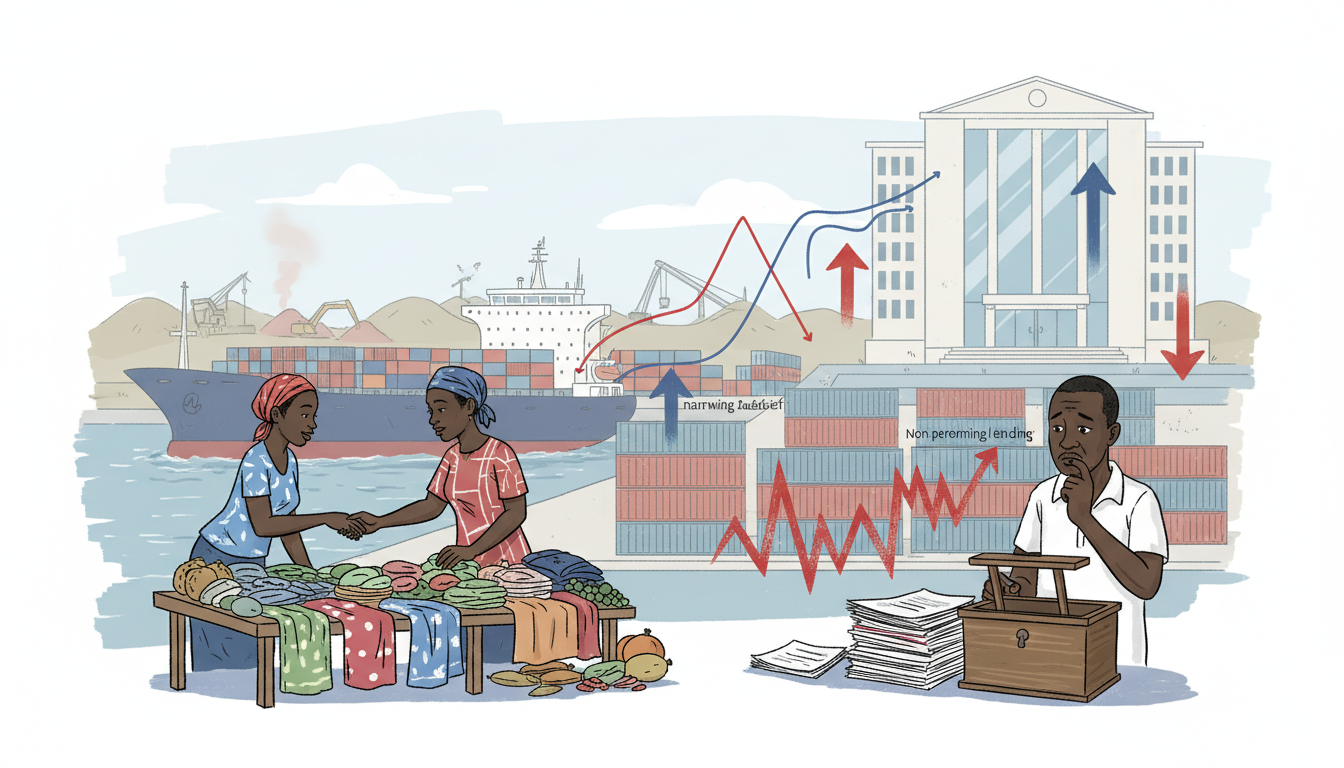
MONROVIA, November 3, 2026 — Liberia’s merchandise trade deficit narrowed sharply in August as export earnings increased and import payments fell, while the country’s gross international reserves and end-of-month exchange rate also improved, according to the Central Bank of Liberia’s latest Monthly Economic Review.
The report, covering August 2026 and posted by the Central Bank on November 2, presents a mixed picture. External-sector indicators strengthened, but inflation edged higher year-on-year, commercial-bank lending declined, and the non-performing-loan ratio remained above the regulator’s stated tolerable threshold.
Trade deficit falls to US$53.71 million
The CBL put Liberia’s merchandise trade deficit at US$53.71 million in August, down from US$92.96 million in July. Export earnings rose 9.4 percent to US$241.04 million, while import payments fell 5.9 percent to US$294.75 million.
Gold remained the largest source of export receipts at US$162.76 million, followed by iron ore at US$60.31 million. The Bank said higher earnings from gold and iron ore, together with lower payments for mineral fuels and food, helped narrow the monthly gap. The report does not establish that the improvement will continue in subsequent months.
Reserves and the end-August exchange rate improve
Gross international reserves increased to an estimated US$971.95 million at the end of August, from US$963.95 million at the end of July. The CBL said this raised import cover to 3.2 months, compared with 3.0 months in July.
The Liberian dollar’s end-of-period exchange rate strengthened by approximately 3.3 percent, moving from L$181.35 to US$1 at the end of July to L$175.60 at the end of August. The period-average rate changed much less, appreciating by about 0.1 percent to L$181.18 per US dollar. These are historical August figures, not a quotation of today’s exchange rate.
Inflation rises year-on-year, but monthly price increases slow
Headline inflation increased to 4.6 percent year-on-year in August, from 4.1 percent in July. Food and non-alcoholic beverage inflation rose to 6.1 percent from 5.5 percent.
On a month-to-month basis, however, headline inflation slowed to 0.9 percent from 2.1 percent. The CBL attributed the year-on-year increase mainly to higher prices for food and non-alcoholic beverages, fuels, and restaurant and hotel services.
Bank lending falls as non-performing loans remain above threshold
The banking sector retained strong reported liquidity and capital buffers. The industry liquidity ratio rose to 58.71 percent, well above the CBL’s 15 percent minimum, while the capital adequacy ratio stood at 38.64 percent against a 10 percent minimum.
But credit activity weakened. Total gross loans fell to L$94.08 billion at the end of August, from L$96.18 billion in July. The non-performing-loan ratio edged up to 12.32 percent from 12.27 percent, remaining above the CBL’s stated 10 percent tolerable limit. The Bank said lower lending to the oil and gas and agriculture sectors contributed to the decline in gross loans.
Production trends remain uneven
Output figures also varied by sector. Iron ore production fell 15.5 percent month-on-month to 2.6 million metric tons, although it remained 61.7 percent above August 2025. Gold production increased 9.4 percent from July to 41,932 ounces, but was still 14 percent below its level a year earlier. Rubber production fell 26.4 percent year-on-year to 5,270 metric tons.
HeartTalk perspective: stronger external figures must reach households
The narrower trade deficit, higher reserves and stronger end-August exchange rate are positive indicators. They do not, on their own, demonstrate that households are experiencing lower living costs or that businesses can obtain more affordable credit. The rise in year-on-year inflation and the continued weakness in bank lending deserve close attention.
For policymakers, the next test is whether the improved external position can be sustained while productive firms, farmers and small businesses gain access to finance. For the public, regular publication of timely, comparable data will be essential to judging whether macroeconomic stability is translating into wider economic opportunity.
HeartTalk Network will continue to track the Central Bank’s subsequent monthly reviews and compare the reported trends with developments in trade, prices, credit and household livelihoods. Speaking from the Heart.
Sources and related reporting
- Central Bank of Liberia — Monthly Economic Review, August 2026 (PDF).
- Central Bank of Liberia — Monthly Economic Review publication page, which lists the August review as posted November 2, 2026.
- HeartTalk Network: Liberia’s Freeport delays face Senate scrutiny.
- HeartTalk Network Daily Digital Magazine — November 3, 2026.