
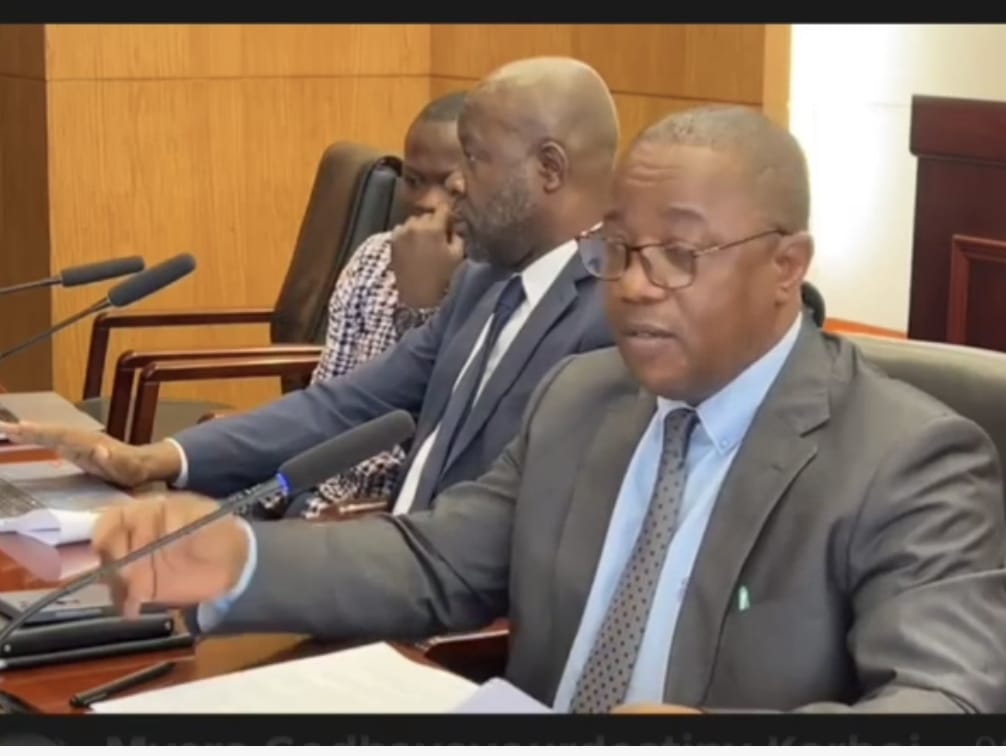
MONROVIA, November 26, 2026 — The House of Representatives has opened a public hearing on the proposed US$1.539 billion national budget for 2027, placing the government’s revenue projections and tax reforms under legislative scrutiny before lawmakers decide whether to approve the spending plan.
The House committees on Ways, Means, Finance and Budget, and Public Accounts began the review with officials from the Ministry of Finance and Development Planning (MFDP) and the Liberia Revenue Authority (LRA). The hearing is intended to test whether the projected revenue can realistically be raised and whether the measures proposed to collect it are sustainable.
Deputy Minister for Fiscal Affairs Anthony Myers and LRA Commissioner General James Dorbor Jallah appeared before the lawmakers. Committee Chairman Representative P. Mike Jurry said the country needs credible revenue forecasts, stronger tax administration and transparent accounting, particularly for income from natural resources and strategic economic sectors.
What the proposed budget assumes
The draft budget submitted to the Legislature provides for a total resource envelope of US$1,538,916,274 for the period January 1 to December 31, 2027. The Ministry of Finance’s budget book says expenditure estimates are set equal to the revenue forecast, in keeping with the government’s balanced-budget approach. The document remains a proposal and has not yet been enacted.
The draft’s resource plan includes approximately US$1.352 billion in core domestic revenue, US$92 million in external resources, US$55 million in carry-forward resources and US$40 million in contingent domestic revenue. The contingent amount is a forecast component, not money already collected, making the credibility of the assumptions an important part of the Legislature’s review.
Myers told lawmakers that tax revenue is projected to rise by 26.5 percent, from an estimated US$847.5 million for 2026 to about US$1.072 billion in 2027. The Ministry expects services, agriculture and fisheries to contribute to revenue growth, while acknowledging that mining receipts can be exposed to international market conditions.
VAT transition is a major test
One of the revenue measures presented at the hearing is the planned introduction of a 15 percent Value Added Tax (VAT), which Myers said is expected to take effect on January 1, 2027 and generate approximately US$224.8 million. He told lawmakers that rice and petroleum products would not be affected by the VAT.
The MFDP’s published draft budget also identifies the transition from the Goods and Services Tax to a VAT system as a key policy measure. It notes that some of the proposed reforms will require further legislation and operational steps. The projected VAT receipts should therefore be understood as a government forecast tied to implementation, not as revenue already secured.
LRA reports US$1.26 billion collected by November 21
Jallah told the House that the LRA had collected US$1.260 billion as of November 21, representing about 97 percent of the approved 2026 budget of US$1.302 billion. He said collections had already exceeded the LRA’s stated revenue target of US$1.181 billion.
According to the Commissioner General, the Customs Department had reached 105 percent of its target while the Domestic Tax Department had reached 99 percent. He projected that total LRA collections would reach US$1.380 billion by the end of the 2026 fiscal year.
Jallah also outlined planned measures to expand revenue administration, including stronger border collections, a National Single Window, electronic invoicing and wider real-property tax administration across Liberia’s 15 counties.
Legislative scrutiny still ahead
The hearing does not amount to approval of the proposed budget. The House and Senate must complete their respective reviews and legislative action before the FY2027 appropriations can become law. The central questions for lawmakers include whether the revenue estimates are achievable, whether new tax systems will be ready on time, and how the government will respond if collections fall below forecast.
For households and businesses, the outcome matters because the proposed revenue measures and spending allocations will shape the resources available for public services, infrastructure, education, healthcare and local development in the coming year.
Sources: Liberia News Agency, November 26, 2026; Ministry of Finance and Development Planning, Draft National Budget FY2027; MFDP statement on the FY2027 draft budget.
HeartTalk Network — Speaking from the Heart.

Leave a Reply