
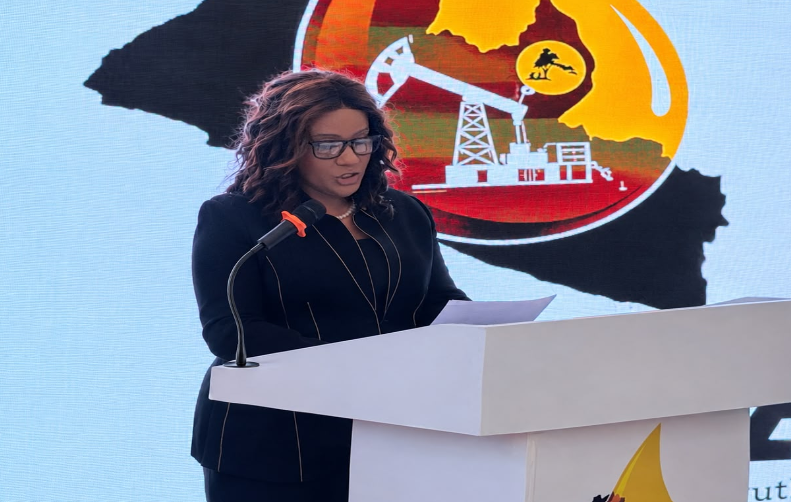
MONROVIA, November 27, 2026 — The Liberia Petroleum Regulatory Authority (LPRA) has launched a five-year strategic plan for 2026–2030, setting out a roadmap for stronger petroleum regulation, local technical capacity, environmental oversight and greater transparency as Liberia seeks to attract investment in offshore exploration.
The plan was unveiled on Thursday, November 26, at the Ellen Johnson Sirleaf Ministerial Complex in Monrovia by LPRA Director General Marilyn T. Logan. At the launch, Logan said the Authority had contributed US$13.8 million to the national budget over the past three years and had secured eight new production-sharing contracts within 18 months of the current leadership taking office in March 2024. She said the Legislature had ratified all eight contracts.
The figures and contract update were presented by the Director General at the launch, as reported by FrontPage Africa. The signing and ratification of production-sharing contracts are steps in the licensing process; they do not by themselves establish that commercial oil or gas has been discovered, that production has begun, or that projected revenues will materialize.
Six priorities through 2030
The strategic plan identifies six priority areas: stronger management of petroleum rights and contracts; development of Liberian technical expertise; improved petroleum data management; protection of the environment and public safety; institutional governance; and transparency and local participation.
Logan said the Authority would begin publishing an annual State of the Petroleum Sector Report in 2027, giving the public a regular account of activity and performance in the upstream petroleum industry. The plan is also scheduled for open reviews in 2028 and 2030.
To strengthen local technical capacity, Logan announced that LPRA’s Technical Department is expected to travel to France in January 2027 for practical training in petroleum data analysis. A second training phase is planned in Monrovia, covering petroleum operations, safety and related technical areas. The Authority says the goal is to build a pool of Liberian specialists able to assess petroleum data and independently review the technical work of international operators.
Exploration activity and investor interest
Logan said a reconnaissance programme is underway in the Harper Basin and that LPRA’s 2026 Direct Negotiation Licensing Round, launched in October, is expected to improve on the results achieved in 2025. These are exploration and licensing activities; they are not evidence of a commercial discovery.
Bertrand Touze, TotalEnergies’ Vice President and Country Delegate responsible for launching the company’s exploration programme in Liberia, said the company had opened a new office in the country and engaged Liberian companies to support its activities. He said approximately half a dozen vessels are expected in Liberian waters in early 2027 to support work on the company’s offshore blocks. The timetable is a company expectation and does not confirm that drilling or commercial production has started.
Environment, safety and public accountability
The plan calls for joint regulatory protocols between LPRA and the Environmental Protection Agency, alongside specialized training for inspectors in health, safety and environmental audits. Logan also outlined plans for risk-mitigation and emergency-response frameworks and for operators’ safety plans to be reviewed before petroleum activities begin.
Minister of State for Presidential Affairs Samuel Stevquoah said the Government expects Liberians to receive a fair share of benefits if international oil companies begin operating in the country. Representative Sam P. Jallah, Chairman of the House of Representatives Committee on Hydrocarbon, described the plan as a framework for measurable targets and said the Legislature would provide oversight and hold the Authority accountable for its commitments.
What the plan must deliver
For Liberia, a stronger regulator could help improve the quality of investment decisions, contract administration and public oversight in a sector where the financial and environmental stakes are high. But a strategic plan is a statement of intended work, not proof that its targets have been achieved. The annual sector report, public access to petroleum information, clear licensing terms, credible environmental safeguards and evidence of local participation will be important tests of progress.
Logan said LPRA would measure its performance by the quality of companies it attracts and its readiness to regulate them in Liberia’s interest, rather than by whether oil is found. That distinction matters: geological outcomes are uncertain, while regulatory integrity, transparency, safety and public accountability are responsibilities that can be measured.
Sources
FrontPage Africa, November 27, 2026, Liberia: LPRA Launches Five-Year Strategic Plan, Discloses US$13.8 Million Revenue Contribution; Liberia Petroleum Regulatory Authority.
HeartTalk Network — Speaking from the Heart.




Leave a Reply