
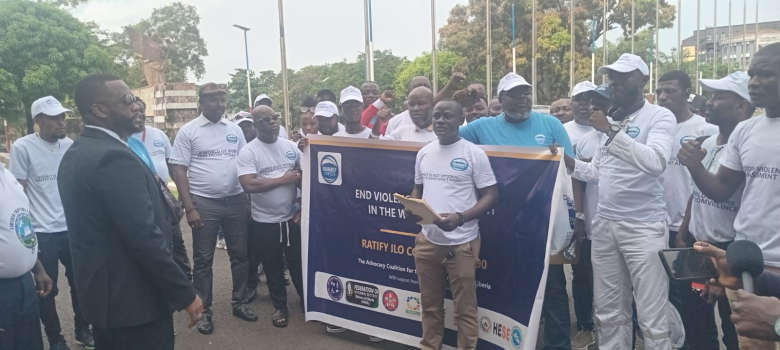
MONROVIA, November 27, 2026 — A coalition of trade unions, civil society organizations and public institutions has petitioned the House of Representatives to begin steps toward Liberia’s ratification and implementation of the International Labour Organization’s Violence and Harassment Convention, 2019 (Convention No. 190), commonly known as C190.
The Coalition for the Ratification of ILO Convention 190 Liberia submitted its formal petition on Thursday, November 26, asking lawmakers to support the international standard and help establish stronger protections against violence and harassment in the world of work. The petition was received by Representative Prince A. Toles, Chairperson of the House Committee on Claims and Petitions.
Toles told the petitioners he would transmit the communication to the plenary for discussion on Tuesday, December 1. That is a commitment to bring the petition before lawmakers; it is not a decision to ratify the convention. The ILO’s official NORMLEX records continue to list Liberia among the countries that have not ratified C190.
What Convention 190 would mean
Adopted by the ILO in June 2019 and in force internationally since June 25, 2021, C190 recognizes everyone’s right to a world of work free from violence and harassment, including gender-based violence and harassment. Its approach extends beyond traditional offices and factories to work-related settings and activities, and is intended to cover workers in both formal and informal employment.
The convention calls on countries that ratify it to develop laws and policies to prevent violence and harassment, provide accessible reporting and complaint mechanisms, protect complainants and witnesses from retaliation, support victims and ensure that violations can be investigated and addressed. Ratification would require Liberia to take steps to align its national framework and enforcement systems with the convention’s obligations.
Why the coalition says action is needed
The coalition says workers across Liberia, particularly women, marginalized groups and people in vulnerable forms of employment, face sexual harassment, intimidation, threats, bullying, exploitation and other forms of workplace abuse. It says underreporting is a serious obstacle because workers may fear dismissal, retaliation, stigma or discrimination, while confidential reporting channels and access to support can be limited.
The petition references a 2026 legal analysis by the Office of the United Nations High Commissioner for Human Rights (OHCHR) concerning the protections available to informal workers, including market vendors and domestic workers. The analysis is available through the UN Human Rights Knowledge Gateway. OHCHR has separately described Liberia’s informal economy as the country’s largest source of employment, engaging an estimated 68 percent of the workforce, while identifying gaps in labour protection, workplace safety and access to remedies. See also OHCHR’s August 2026 report on informal workers in Liberia.
The coalition also cited national gender-based violence figures in support of its case. Those figures describe the broader GBV situation in Liberia and should not be read as counts of workplace harassment alone. The distinction matters because better data specifically on violence and harassment at work will be necessary to measure the scale of the problem and the effect of any reforms.
What petitioners want lawmakers and Government to do
The coalition asked the House to refer the petition to the appropriate committees, particularly those responsible for labour, human rights and gender equality, and to transmit it to the Executive Branch for review. It also urged lawmakers to consider a resolution supporting ratification and implementation.
Among its other recommendations are a national tripartite dialogue involving Government, employers, workers’ organizations and civil society; review of national laws and policies to cover both formal and informal employment; confidential reporting systems; protection against retaliation; access to support services; and stronger accountability for perpetrators. The coalition also called for public education and better data collection.
The coalition includes the Solidarity Center, United Worker Union of Liberia, Federation of Informal Workers of Liberia, WONGOSOL, BLESSING-Liberia, Health Education and Sustainable Empowerment, Inclusive Development Initiative and the National Parent Teacher Association of Liberia. The Ministry of Labour and the National Commission on Persons with Disabilities are identified as honorary members supporting the initiative.
Next step: plenary consideration
The immediate test is whether the petition is placed before the House on December 1 and referred for substantive review. A public discussion could help clarify which national laws need revision, what enforcement resources are required and how protections can reach workers whose jobs are outside conventional employment arrangements.
For Liberia, ratification would be only the beginning. Effective protection would depend on clear rules, trained labour inspectors, safe complaint channels, accessible remedies and practical safeguards for workers who may be economically dependent on an employer or unable to risk losing their livelihood by reporting abuse.
Sources
FrontPage Africa, November 27, 2026, C190 Coalition Engages House on Ratification of ILO Convention Against Workplace Harassment; International Labour Organization, C190 instrument profile and Conventions not ratified by Liberia; OHCHR, Workers in the Informal Economy in Liberia — A Legal Analysis and August 2026 report on informal workers in Liberia.
HeartTalk Network — Speaking from the Heart.
Leave a Reply